Medieval music concerts
Show, festival (concert, dance, theatre)
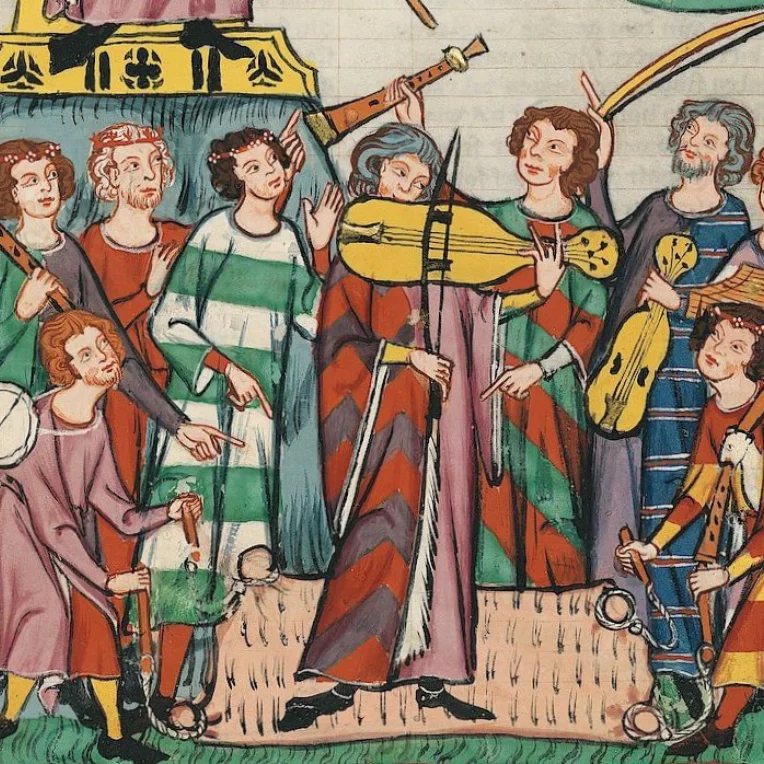
As part of the Medieval October event, come and enjoy a series of medieval music concerts at the Cathedral Basilica of Saint-Denis!
-
Saturday 3 October 2026 at 4.30 pm
Saturday 10 October 2026 at 4.30 pm
Friday 16 October 2026 at 8.00 pm
Saturday 24 October 2026 at 4.30 pm
-
Prices
From €17
Get 20 per cent off your basket with the promo code OCTOBRE20 (offer valid for concerts on 3, 10 and 24 October 2026, when purchasing a set of two tickets).
-
General public
-
Enquiries
noemie.nunes@monuments-nationaux.fr or 06 12 28 76 60
- Buy your ticket
Overview
As part of the‘Medieval October’ programme at the Cathedral Basilica of Saint-Denis, a series of five medieval music concerts will be held in the monument’s Gothic chancel.
The venue’s remarkable acoustics will highlight the full richness and diversity of the compositions performed, offering the audience a unique auditory experience. The vast repertoire, ranging from sacred to secular music, together with the variety of period instruments used by the musicians, will reveal a medieval musical culture that is both delicate and powerful. At the end of each concert, the professional ensembles, specialists in medieval music, will present their instruments to the audience and share historical and artistic context relating to their programmes, fostering an enriching dialogue.
For six consecutive years now, the basilica has been proud to host these exceptional musical events. This year’s edition once again promises some highlights, featuring renowned ensembles.
In addition, a series of talks led by specialists in the medieval period will also be held at the basilica as part of ‘Medieval October’. These sessions will offer the chance to deepen one’s understanding of the Middle Ages through historical, social and artistic topics. To find out more about these talks
Concert programme
SATURDAY 3 OCTOBER – 4.30 pm
‘Ai Lemozi: from monastic chant to the lyric poetry of the troubadours in Aquitaine’ by the Beatusensemble
The Gradual of Saint-Yrieix contains chants which, in the11th century, formed part of the Gregorian repertoire transmitted throughout Europe, as well as those from a regional repertoire specific to Aquitaine and, more particularly, to Saint-Yrieix. This Gradual is the sole source of twenty-one antiphons dedicated to Saint Aredius (the Latin form of Yrieix) and other local saints, as well as an exceptional collection of chants belonging to the Gallican tradition, that of the Christians of Gaul under the Merovingian dynasty. The Abbey of Saint-Yrieix retains its own distinct liturgical identity, centred on the veneration of Saint Aredius and Saint Martin, despite the growing influence of the powerful neighbouring Abbey of Saint-Martial in Limoges, which came under the Cluniac Order from 1062 onwards. It is from this Abbey of Saint-Martial that we have the earliest evidence of polyphonic chant. A contemporary of this revival of monastic chant, William IX of Aquitaine (1071–1127) drew inspiration from the splendour of a centuries-old monastic tradition to foster a counter-movement: that of courtly lyric poetry, centred on the joy of love, which celebrates and questions the beauty of nature, but also the harshness and folly of the world.
The Beatus Ensemble
Performers: Stephan Olry (vocals), Erwan Picquet (vocals), Jean-Paul Rigaud (vocals, harp, fiddle, artistic director)
The Beatus Ensemble is dedicated to presenting musical works from the Middle Ages from a contemporary perspective. From Gregorian chant to the School of Notre-Dame, via the early polyphonic works of Saint-Martial de Limoges and the courtly lyric poetry of the Limousin troubadours (12th–13th centuries ), to the works of the great15th-century composers, the Beatus Ensemble has set itself the aim of exploring these repertoires in relation to contemporary artistic, musical and literary creation. It thus creates performances incorporating other disciplines in partnership with theatre and dance companies.
The ensemble presents programmes in which contemporary and medieval music converge in a shared spirit. It also extends its programmes to include Eastern cultures, building bridges between East and West. Find out more about this ensemble
This concert will, exceptionally, be free of charge. A free ticket can be collected on the day from the box office and will also grant you access to the rest of the tour.
SATURDAY 10 OCTOBER – 4.30 pm
‘Gothic Paris: a musical guided tour of Paris in 1250’ by the Rue des Chantres ensemble
Come and immerse yourself in the music of Rue des Chantres as you explore Gothic Paris in 1250! The tour will begin at Notre-Dame, where construction of the south tower has just been completed. You’ll pass by the Sainte-Chapelle, the Palais de la Cité, the Petit Pont leading to the Left Bank, and Montagne Sainte-Geneviève, before heading down past the University of Paris – the most prestigious in the West – and on to the Benedictine Abbey of Saint-Germain-des-Prés. Along the Seine, you’ll see Les Halles and its market traders, Montmartre, where Saint Denis, the first Bishop of Paris, was beheaded, and you’ll return to Notre-Dame, where the choristers will proclaim their love for this city where ‘anyone who has left it against their will cannot help but return’.
The Rue des Chantres ensemble
Performers: Erwan Picquet (vocals), Vincent Pislar (vocals), Christian Ploix (vocals)
In 2019, Erwan Picquet, Vincent Pislar and Christian Ploix founded the flexible ensemble Rue des Chantres, named after a street on the Île de la Cité situated a stone’s throw from Notre-Dame Cathedral in Paris. Having themselves been cantors at Notre-Dame, they have set themselves the aim of bringing to life the chants that have resounded within the cathedral throughout history, in particular the polyphonic works known as those of the Notre-Dame school, which spread to the great Gothic cathedrals of13th-century Europe.
When putting together their programmes, they go back to the sources and immerse themselves in the study of medieval musical manuscripts, painstakingly copied by monks. Their concerts feature improvisations, which were much to the liking of medieval audiences. A slideshow featuring translations, iconography and manuscripts relating to the pieces performed may be projected during the performance.
Since 2021, they have forged a strong link with the Saint-Denis Cathedral Basilica – Centre des monuments nationaux (CMN) by performing there regularly. The ensemble is supported by the town of Pantin. Find out more about this ensemble
Buy your tickets for this concert
FRIDAY 16 OCTOBER – 8.00 pm
‘The Angel Musicians: Discovering Medieval Instruments’ by the Obsidienne ensemble
The Obsidienne ensemble invites you to (re)discover the instruments played by the angelic musicians that adorn medieval churches and cathedrals. These instruments also feature in numerous manuscripts, the most famous being the Codex of the Musicians from the Cantigas de Santa María.
In Sens Cathedral, the sixty-two angel musicians of the north rose window – known as the ‘Rose of Paradise’ – showcase the stylised instrumentarium of the late Middle Ages, featuring art music, folk music and pastoral music, drawing on biblical and symbolic instruments from ancient texts. Unfortunately, almost no instruments have survived the test of time. Iconography, musicology, musical practice and similarities with certain traditions that still exist today make it possible to recreate these instruments, which might otherwise have been thought lost. The Obsidienne ensemble brings these ancient melodies to life today by restoring the tonal colours of the medieval orchestra. Throughout the concert, you will hear more than twenty instruments: bowed viols, citole, crwth, rebec, jaw harp, clappers, triangle, vèze, bagpipes, double flute, flutes with three, six and eight holes, chalumeau, flute and drum, choron (stringed drum), horn, cornet, chalumeau, psaltery, tympanon, vihuela, seashells, cymbals…
These instruments, which will captivate young and old alike, will be brought to life through a varied repertoire, notably the Cantigas de Santa María and songs from the Bayeux Manuscript.
The Obsidienne ensemble
Performers: Florence Jacquemart (voice, 3-, 6- and 8-hole flutes, double flute, bagpipes, vèze, chalumeau…), Hélène Moreau (voice, psaltery, seashells, castanets, sistrum, string drum…), Camille Bonnardot (voice, citola, guiterne, vihuela, portative organ, horns…), Colin Bonnardot (vocals, percussion), Ludovic Montet (vocals, tympanon, percussion), Emmanuel Bonnardot (vocals, fiddle, rebec, crwth, chifonie, jaw harp, horn, artistic director)
Led by Emmanuel Bonnardot, the vocal and instrumental ensemble Obsidienne is dedicated to bringing to light unpublished and little-known repertoires from the Middle Ages through to the earliest polyphonic works of the Renaissance, readily blending interpretation and improvisation. Renowned for the finesse and poetry of its instrumental and vocal phrasing, Obsidienne is now one of the leading ensembles in the performance of medieval music. Having held a residency in Sens, Burgundy, since 2009, the ensemble explores the theme of ‘song from the Middle Ages to the present day’, broadening its repertoire to include other eras and readily forging links with poetry, theatre and dance…
Alongside its creative work and national and international performances, Obsidienne runs a wide range of community initiatives aimed at all audiences, young and old, students, music lovers and professionals alike… ‘La Reverdie’, a travelling spring festival in rural areas launched in 2019, is the highlight of these efforts.
Its discography (Bayard Musique, Eloquentia, Calliope, Opus 111) has received numerous accolades from the French and international press (Académie Charles Cros’s ‘Coup de cœur’, Grand Prix du Disque, Diapason d’or, etc.). Find out more about this ensemble
Buy your tickets for this concert
SATURDAY 24 OCTOBER – 4.30 pm
‘Je loe amours: songs at the court of Burgundy inthe 15th century’ by Anne Delafosse and Angélique Mauillon
Inthe 15th century , before the advent of music printing (1501), the extent to which a composer’s works were circulated in manuscripts was the main indicator of their popularity. Whilst Gilles Binchois (c. 1400–1460) and Guillaume Dufay (1397–1474) are, in this respect, unquestionably the leading composers of French chansons of themid-15th century , it should be emphasised that their musical style was similar to one that had already been cultivated for many years by their masters and predecessors. Jacques Vide (active c. 1405–1433), Pierre Fontaine (c. 1380–c. 1450) and other little-known, often anonymous composers developed a new style that placed great emphasis on the intelligibility of the text and on musical structure. This new style stands in stark contrast to the ars nova and the ars subtilior: complex rhythms are contrasted with simple ones, whilst long phrases laden with melismas and syncopations are contrasted with short, syllabic musical phrases, separated from one another by clear cadences, pauses and characteristic rhythmic patterns.
Most of these songs are preserved in the highly valuable manuscript Ms Canon. Misc. 213 (Oxford, Bodl. Library), thanks to the diligence of an Italian music lover who transcribed the many songs in this new style that passed through his hands, before his eyes or to his ears!
The theme of these songs? A love described as courtly, which can be summed up in these lines:
‘When the sweet young maiden,
so graceful and fair,
the one with whom I am in love,
wishes me to be cheerful,
must I not obey her?’
Performers: Anne Delafosse (voice), Angélique Mauillon (harp)
For a quarter of a century now, Anne Delafosse and Angélique Mauillon have been exploring the15th-century courtly repertoire together, a testament to their close collaboration on these delicate courtly songs. These marvels of music and poetry are so dear to them that their enthusiasm for sharing them with an audience curious about that era, that culture and that aesthetic is evident on every occasion.
Anne Delafosse
Anne Delafosse’s concerts are few and far between: for the past ten years, she has devoted herself to the Conservatoire national supérieur de musique et de danse de Lyon, teaching medieval and Renaissance music and working in a coordinating role. Early in her career, Anne learnt to sing under Marie-Claire Cottin and went on to specialise in early music under Dominique Vellard, Marie-Claude Vallin and Eugène Ferré, amongst others… She was the principal singer of the ensemble Doulce Mémoire and performed with the ensembles Musica Nova, Discantus, Mora Vocis, Céladon and Gilles Binchois. Following several one-off projects – Vox Audita Est, Dafné, Inconstance and Vanité du Monde – she founded the ensemble Les Jardins de Courtoisie in 2004, which went on to give ten years of concerts and recordings. Today, she is based in Berry, where she works to promote both musical and architectural heritage.
Angélique Mauillon
After studying classical harp, Angélique Mauillon chose to specialise in the performance of early music. She studied under Eugène Ferré at the Conservatoire national supérieur de musique et de danse de Lyon, and under Mara Galassi at the Scuole Civiche in Milan. For over twenty years, Angélique Mauillon has been performing a vast repertoire, spanning almost seven centuries of music on a variety of instruments, from the earliest monodic songs of the troubadours to the sonatas of the Age of Enlightenment. She has taken part in numerous productions with ensembles such as Le Concert d’Astrée, Pygmalion, Correspondances, Doulce Mémoire, Ground Floor and Tasto Solo. Having also collaborated on more than thirty recordings for the labels Alpha, Harmonia Mundi, Eloquentia and Ricercar, she released her first solo album in 2022, dedicated to17th-century French and English music, which was widely acclaimed by the international press. Holder of the Certificat d’Aptitude, she teaches at the Conservatoire à rayonnement régional de Tours and at the Conservatoire national supérieur de musique et de danse de Lyon.
In pictures

© Alex Overton

© Alex Overton

© Alex Overton

© Santiago Torralba

© Hervé Letourneur

© Julien Tosi
