Art & Architecture
article | Reading time7 min
Art & Architecture
article | Reading time7 min
In the 12th century, the architecture of the Basilica of Saint-Denis evolved under the guidance of Abbot Suger. Stained glass, coloured light, and open spaces: enter the cradle of Gothic art in Europe!
Built around the tomb of Saint Denis, who died around the year 250, the church was a modest chapel 20 metres long in the 5th century. Enlarged during the reign of Dagobert, a new building was later consecrated in 775 in the presence of Charlemagne. It was an immense Carolingian basilica, known as "Roman style", 80 metres long with marble columns and their magnificent bases and wooden vaults.
In the 12th century, the building underwent major renovations under the direction of Abbot Suger, elected in 1122. Suger deemed the abbey too small to accommodate the large numbers of faithful who had come to honour the relics of the saints, so he decided to enlarge it. He even wrote:
The distress of the women was such and so intolerable that one could have seen them with horror, crushed as if by a press in the melee of robust men, uttering terrible cries, several of them, miserably pallid, lifted by the pious help of the men above the heads of the people, thus advancing as if on a pavement, and many of them breathing their last to the despair of all.
Abbot Suger
Centre des monuments nationaux
Suger drew his inspiration from various writings, the Bible, of course, but also the texts of Pseudo-Dionysius the Areopagite, one of the major sources of Christian mysticism, whose Greek texts had been translated into Latin and distributed by the abbots of Saint-Denis. In particular, he retained the idea of a metaphysics of light. Suger reaffirmed that light was divine in essence and that it was the very word of God, the Word. This association between light and construction is one of the guiding principles of the project.
Innovation was another. Suger surrounded himself with the best workers of the time to bring his project to fruition. At Saint-Denis, they developed a new way of building, known from the 13th century as the French art (opus francigenum). But we know it better as the Gothic style, a term of contempt coined in the 16th century by the Italians to denigrate a style that had no reference to classical art, a barbaric art! The term came into its own again in the 17th century and especially in the 19th century, with the public's infatuation with the Middle Ages.
Centre des monuments nationaux
The Gothic revolution was not based on a single groundbreaking invention. The advent of Gothic architecture in the Île-de-France region came after two centuries of major economic growth in Europe. Gothic architecture was a continuation of Romanesque art, a term coined in the 19th century to assert its links with Roman art. It was born around the 9th century and developed throughout Europe, from Spain to Scotland, even in parallel with Gothic architecture. It is true that Romanesque art was characterised by its more massive lines and vaults, but Cluny III (1088-1130) in Burgundy already had a barrel vault more than thirty metres high!
Instead of barrel vaults or cross vaults , the Gothic style systematically adopted the rib vault , which was already in use in England in 1090. It was the slow evolution of construction methods, the development of buttresses , and the quality of stone-cutting that made it possible to build increasingly high walls pierced with large windows designed to accommodate immense coloured stained glass windows. In the 13th century, builders also used more and more metal to construct taller, larger and brighter buildings - up to fifty tonnes of metal in Beauvais Cathedral!
In short, Gothic architecture, nourished by a new relationship between man and nature and his Creator, was based on the importance of light and the decompartmentalisation of spaces.
Centre des monuments nationaux
Let's return now to the basilica of Saint-Denis. From 1130 to 1140, Suger directed the construction of a new western façade, which was equipped with a rose of an unprecedented size! Then, from 1140 to 1144, the abbot had the chevet built on the east side of the church , a new manifesto of Gothic art, which he claimed to have completed in three years, three months and three days - a symbolic figure, of course!
It has seven continuous, shallow radiating chapels, with no partitions between them. All that can be seen is the simple undulation of the outer wall decorated with stained glass windows, which, according to Suger, creates an admirable and uninterrupted light (lux mirabilis et continua). The entire chevet is supported by two rows of elegant monolithic columns, forming an ambulatory, columns that symbolise the twelve apostles and the twelve prophets.
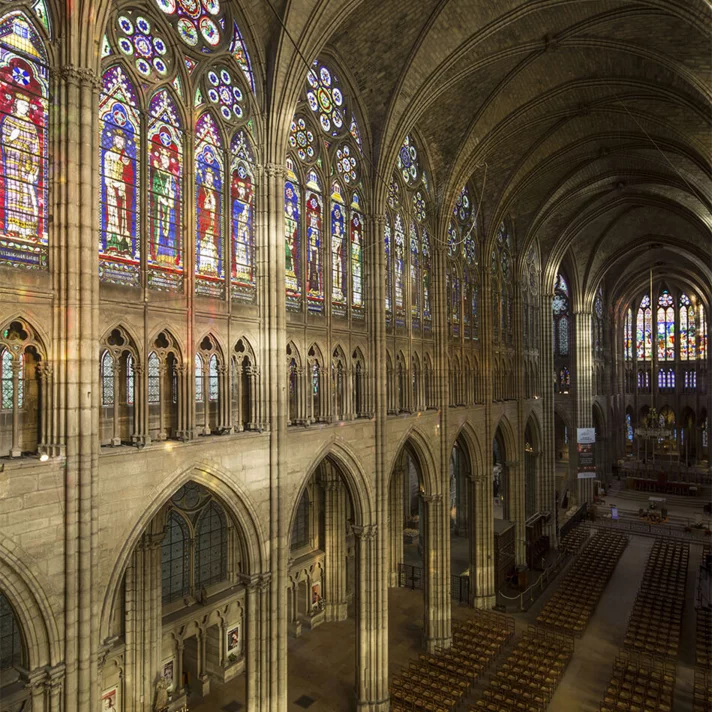
The architectural work at Saint-Denis is an exceptional creation that demonstrates what Gothic architecture is all about: the obliteration of the wall, the total fusion of volumes and the beauty of the light from the coloured stained glass windows!
The splendid stained glass windows flood the space with light. They depict different episodes from the Bible, such as the Infancy of Christ or the Tree of Jesse, the first monumental representation of a theme that was famous throughout the Middle Ages. Rich in colour and theological references, they were primarily intended for the most erudite monks, to encourage their spiritual reflection.
Jean Feuillie / Centre des monuments nationaux
On 11 June 1144, the chevet of the basilica of Saint-Denis was consecrated by Abbot Suger and twenty-four bishops and archbishops who had made the trip, including the English archbishop of Canterbury! To crown his work, the Abbot invited King Louis VII of France, to whom he was a close adviser, accompanied by Queen Eleanor of Aquitaine. And it was in a grandiose procession that the relics of Saint Denis were transported from the dark crypt where they had lain for centuries to the light of the new building, in an altar adorned by Suger himself with the most precious and luminous jewels he had been able to procure!
Everyone marvelled at such beauty, the kind that leads "to the true through material things", as the abbot had inscribed on the church's entrance portal, thus materialising the relationship between the divine and light.
The various prelates then returned to their respective dioceses, left with lasting impressions of this new architectural experience. This marked the start of new projects, such as Sens Cathedral (1130-1164) and other increasingly bold monuments in Chartres, Amiens and Reims!
Pascal Lemaître / Centre des monuments nationaux